The Exile

5 minutes
394 AC
During the first few weeks, speaking with the Reka was no easy task. I had to patiently listen to the interpreters and rely on numerous translators and transcribers… The Ordis linguists, assisted by the Yzmir Horomancers, naturally set themselves to deciphering their language: syntax, phonemes, writing, and grammatology. Yet the greatest breakthroughs came through Alteration. The Lyra extracted the ideas contained within the spoken words, allowing us to visualize them and thus understand them, word by word. We began with rudimentary concepts and terms before moving on to more complex associations. Fortunately, the Reka language appears to share some similarities with Asgarthan, probably because of common roots. Willingly or not, and even though the process was extremely laborious, we eventually managed to make ourselves understood. Some linguistic or cultural subtleties still escape us, of course, but little by little we will surely manage to dispel them.
Common origins
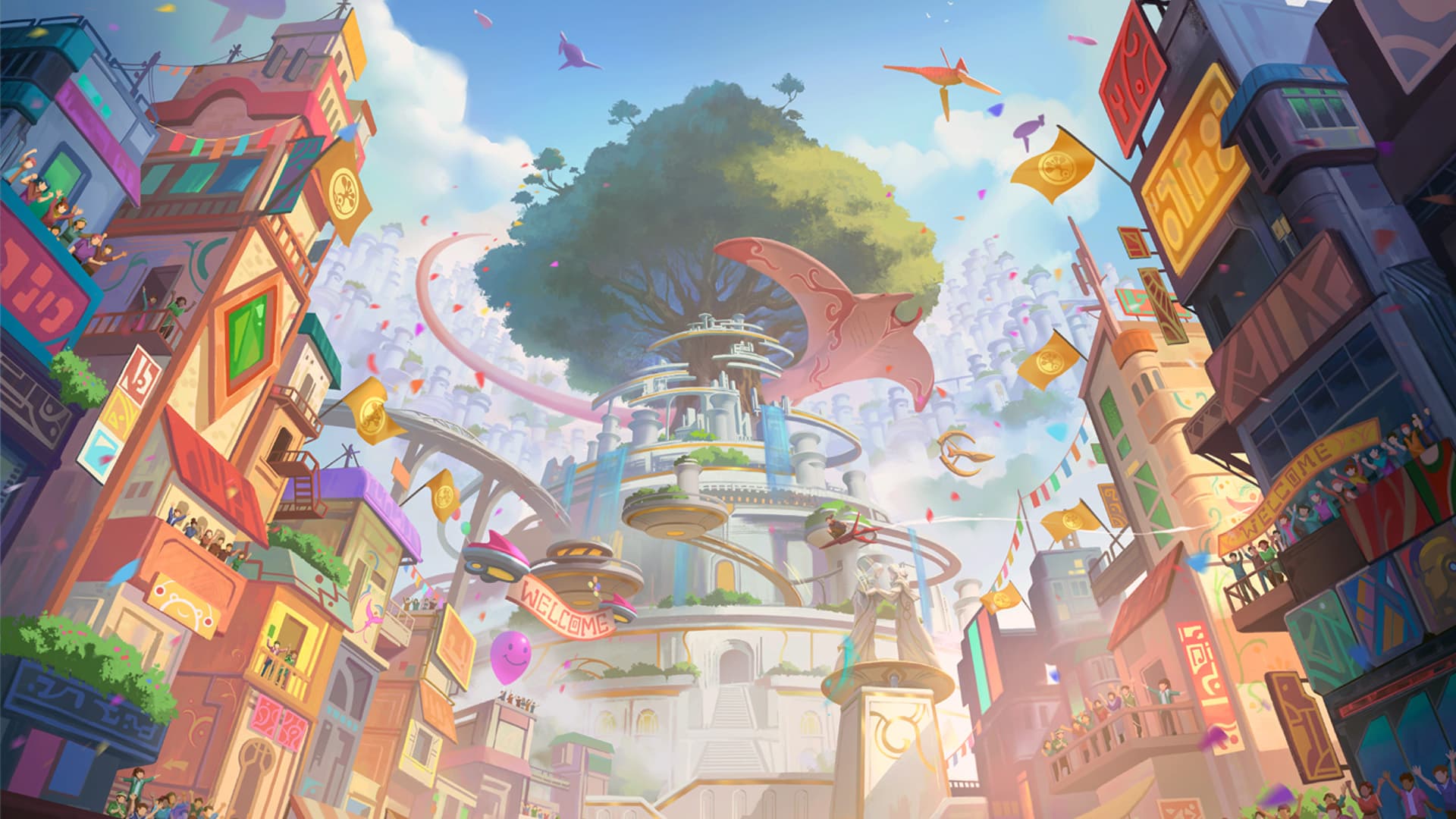
After discussing the matter further with Sree, it seems clear that Reka architecture shares striking similarities with that of the City of Scholars, which the Reka have always called Sofia. In the presence of the Eidolon, I was able to speak with a Reka historian named Penggarun. According to him, their ancestors converged on Asgartha alongside the other Tumult Nomads. But instead of continuing their journey, they stopped at Sofia for reasons that remain unclear. The old annals mention a Tumult storm—perhaps a Singularity. They chose to halt their wandering because something there seemed to shield them from the violence of the mutagenic currents. By cross-referencing the dates with Leocardius, we believe this decision was made roughly twenty years before the founding of Asgartha.
At first, this stop was only meant to be temporary, until the Tumult Singularity subsided. Reka mythic traditions evoke several legendary figures: their Shepherdess, from whom the entire people took their name after her death; the prophetic figure of the Drifter, who came to them out of the Tumult to help them prosper; and the departure of Baird y Idris, who swore he would return with reinforcements from the other Tribes, yet never came back. These pseudo-historical fragments are like pieces of a puzzle that also seem to align with our own history. Leocardius believes that by comparing the archives of the Sanctum with those held by the Reka, he may illuminate the darker corners of our past. He hopes to find the missing pieces that will allow our two peoples to be linked within a shared chronology.
The price of prosperity
But it was when the Reka began exploring the surroundings of the City of Scholars that their sedentarization became permanent. Nestled within a mountain, they discovered a tree of incredible proportions, which they too identified as a world-tree. They named it Vilagfa and discovered that its sap possessed both nutritional and energetic properties. What they called Nectar, and what we call Sap, became the focal point of their civilization. It was through this substance that the Reka people prospered despite their isolation, achieving remarkable feats—without realizing that this bounty would also bring about the downfall of their society.
As we already knew, Sap had become central to their lives. It powered the city constantly. The pipelines that carried it through the various districts became a kind of circulatory system. According to Penggarun, the Reka ancestors discovered that feeding something with Sap granted it a proto-consciousness, a semblance of cognition. Yet even they never suspected that the City of Scholars itself would come alive. And yet, when Sofia reached full consciousness, the Reka celebrated her birth. More than that, they made her their tutelary goddess, their protective divinity—the embodiment of their very matrix. At first she was their child, but over generations she became something closer to a maternal figure.
But the prosperity of their people was in fact a disaster waiting to happen. Sap had enabled an incredible technological revolution, and each day saw the creation of more devices powered by it. At the same time, the birth rate also soared: Sap fed the population, strengthened their immune systems, and shielded them from the Tumult. To cope with this unstoppable demographic boom, Sofia could, through her own will alone, generate new districts and dwellings within herself. These would appear almost magically, ready to house new families in unexplored recesses, cavities that had never before been discovered. But her omnipotence came at a price. She too had to be fed Sap, and the larger she grew, the more voracious her appetite became.
Hunger and madness
Penggarun admitted to me without hesitation that their ancestors had been blind to the precipice slowly opening before them. They let the Sap flow—ever more, ever more. They cut into the trunk of the Vilagfa to harvest it and channel it toward the city. In the end, it was as though they were keeping the city permanently on life support. Gradually, after more than a century and a half of increasingly intensive exploitation, the world-tree began to wither. It was an inexorable decline. Measures were taken: the bleedings became more sporadic, and rationing was introduced. But Sofia herself suffered constantly from the shortage. Immortal though she was, that did not spare her from pain. She was tormented by an endless hunger gnawing at her insides, and nothing could ease it.
I can only imagine it: the city rumbling, each spasm a tremor; hunger gnawing at her and dragging her toward madness. Suffering with no possible escape. In truth, I cannot help but feel pity for her, considering all that she endured. Her pain became so great that the deepest reaches of the city began to mutate, to twist and distort, swallowing those who strayed too far from the beaten paths. When I questioned Penggarun about the theft of memories and thoughts, even he could not say how it began. According to him, Sofia eventually began, almost out of spite, to siphon off the recollections and imagination of the inhabitants in order to soothe her torment—like a drug, a fleeting balm, a palliative. Something to quiet the constant gnawing of her hunger. But what the historian told me next was even more tragic—and cruel.
The Ascension
The Reka leaders of the time understood that the situation had become hopeless. Yet during their reckless harvesting of Sap, they had discovered a seed—a single fertile seed of the world-tree. They guarded it carefully. Around that fragile hope, a plan began to take shape. In secret, they started storing Sap, enough to sustain them until the new world-tree would be ready to produce. Naturally, they concealed it from Sofia, in cisterns beyond her reach or outside the city altogether. At the same time, they mined Aerolith again and again in order to create a way out. To flee far beyond her grasp and abandon her to her fate. For years—perhaps even decades—the Reka turned the upper part of the city into a floating enclave that was only waiting to cast off its moorings.
This irrevocable flight, this deliberate exile, is what the Reka call the Ascension. One day, more than two centuries ago now, the city rose into the sky, floating above the clouds, far from their gilded prison. The anniversary of that event is still celebrated today within Reka society as a day of liberation. By rationing the Sap they had stored, they endured long enough to see the Naos blossom and grow. But instead of bleeding it as they once had, they now harvest its fruits and extract their juice. For two centuries their wandering city has drifted among the clouds, cut off from the rest of the world by an ocean of Tumult. Reka society evolved in isolation, adrift upon an archipelago in slow decay that gradually fractured into pieces. Two centuries of isolation that we have only just broken.
Logbook of Temera Singh, Grand Admiral of the Expeditionary Corps 394 AC, March 11