Remnants

5 minutes
393 AC
I look at the child and the giant fish accompanying him with a certain tenderness. The two beings seem to exist in perfect osmosis. When the boy looks left, the Chimera does the same. Each of their movements either completes or mirrors the other. It is fascinating to watch—and at the same time, it leaves me with a faint sense of unease.
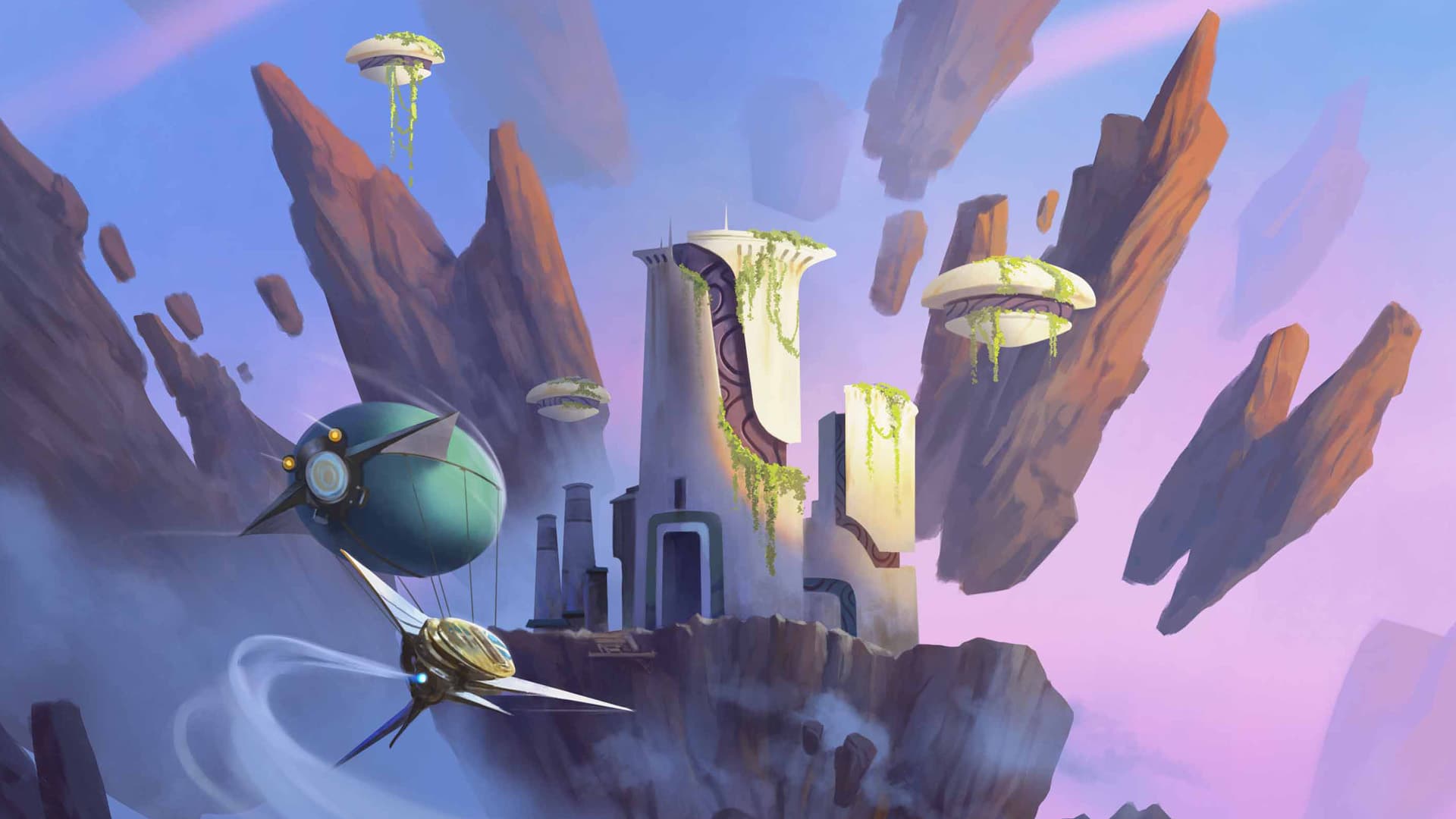
Our destination draws closer by the second: a small floating island in the Pelagonian Quadrant. The other participants in the expedition bustle about inside the mechanical vessel provided by the Axiom. At last, the first ruined structures come into view, and a few curious onlookers rise from their seats as murmurs ripple through the crowd. It is always exhilarating to uncover the traces and remnants of human activity—those unknown people who came before us in these places.
The other specialists invited by Sree for this visit feverishly pull out their notebooks and various recording and measuring devices. They come from vastly different fields: historians, architects, ethnologists, sociologists, all quivering with curiosity and hungry for new knowledge. I must admit, I am one of them. But the child and his fish remain contemplative, mere spectators to this grand scientific circus.
The skiff slows and maneuvers to come alongside the dock built by the Axiom. The group disembarks in disarray, buzzing, chattering. For a moment, I wonder where Suha has gone before stepping down myself. The child waits until all the adults have disembarked, then follows the flow calmly. Behind him, his companion brings up the rear. I slip into the throng of busy people.
We reach the first building—the first point of interest. Only collapsed sections of wall remain. About half the group seems inclined to stop there. Already, hypotheses fly, analyses intersect, clash, contradict one another, then dovetail.
I cast a distracted glance toward the child. He seems intent on continuing with the rest of the procession, so I follow him. His name is Nadir, apparently—a child of the Tisdhera Clan and his Chimera, elevated to the rank of Exalt. Originally from Wayfarer. Beyond that, there was little of substance to uncover, truth be told, despite the research.
A large white building reveals itself, its walls set with golden geometric lines. Even though it is not my place to pronounce on such matters, it seems obvious to me that its architecture shares a common style with that of the City of Scholars. There is no real doubt about it—but let’s move on. That is not why I am here.
We step inside and discover numerous frescoes, now dulled by time. Sap is everywhere. Bas-reliefs cover every wall. A place of worship—or of remembrance? The patina makes the scenes difficult to read.
The Exalt studies the painted engravings just as intently. Hands and fins brush the walls, graze them…
I close my Gestalt, then open myself to my second bond.
Suha.
The connection is immediate, a blend of joy and restraint. She understands at once what I need and unfolds her Irises.
Nadir calls upon Alteration to revive the colors. Like a sheet of paper soaking up water, the wall he touches becomes vibrant where it had once been washed out. His Alter Ego spins playfully and lashes the air with its tail fin, creating a current that splashes against the wall, bathing the fresco in renewed color.
But that is not what I am watching. What interests me is the way Nadir’s aura flickers—almost imperceptibly.
I don’t think he’s one of them.
I sigh, reaching the same conclusion as my other half.
Still, there’s something strange, I reply.
But this isn’t our mission, Yanna.
I nod. It’s time to mute our Musubi. Once Suha’s presence is reduced to a minimum—barricaded in a corner of my psyche, as she taught me to do—I touch my Rhombus and let the Coalescence embrace me once more.
All that remains, it seems, is to enjoy the visit and do what I was called here to do. I open myself to the college of linguists. One by one, I feel them accept the connection. Some are on Mandjet; others remain within the Sanctum. And as I sense them appear at the edge of my awareness, it becomes clear that the Town Hall’s Espar is fully operational.
All right. Let’s begin. I examine the scripts bordering the murals. They have a cubical form, somewhat like those of the Tribe of the Setting Sun, which suggests the two languages likely share common roots.
Through the Heka, I siphon the concepts contained in the ideograms. The act of translation is collective; the texts are refined, the phrasing polished until consensus is reached. There are internal debates, hesitations, clarifications—but after only a few minutes, the panels are decoded, interpreted, transcribed.
‘The Világfa is dying, but a fertile seed has been found.’
I study the panel in question, which depicts a world-tree withering, and human figures exhuming a seed. The Nilam?
Hmm. I would lean more toward égig érő fa—“the tree that reaches the heavens”…
I turn to the second scene, showing people loading golden liquid, lavishly represented with sculpted Sap. They appear to be acting furtively, taking great care to ensure their ruse is not discovered by a towering woman depicted out of proportion, her hair writhing like tentacles.
‘In secrecy and patience, the Juice was gathered.’
I think “Nectar” would be more accurate.
Your remark has been duly noted, dear colleague.
The third wall shows a city perched on a mountain, like a Tower of Babel, into which the collected Sap is clearly being channeled in great quantities, flowing like golden rivers. At its summit, a tree is planted, surrounded by people praying to it.
‘During the Ascension, the shoot shall be planted, and the skies shall be our freedom.’
This time, the translation meets with unanimous approval.
The fourth and final wall depicts the upper portion of the city, as though it has been severed, levitating above the clouds amid an archipelago of floating islands. On every atoll stand silhouettes, as though the fugitives gradually colonized these suspended lands.
But then—where are they now?
Indeed, the place where I stand is clearly abandoned. In nearly every Quadrant, we have found traces of passage and ruins—but not a single living soul. What happened? Did they face yet another catastrophe?
No hasty conclusions, please. What we know is that the inhabitants of the City of Scholars—or at least some of them—stockpiled Sap without the Hunger noticing. They also fashioned a tower, within which they planted a Nilam seed…
While the world-tree grew, they surely needed supplies to survive.
I believe so as well, dear colleague.
And the tower rose. They broke their chains!
Those found on the Screed?
Which proves once and for all that the City’s inhabitants had indeed domesticated Aerolith.
Perhaps even better than we have, in the end…
But that means the crater—yes, that must be it!
I let them debate while narrowing my eyes. A detail whose meaning escapes me has caught my attention. On the fourth fresco, a stylized silhouette—like a ginkgo leaf—floats above the growing world-tree.
Yanna?
I blink, slightly embarrassed at having drifted off.
Yes?
Are you comfortable validating this interpretation?
‘Sofia became the Hunger. The inhabitants of the City sought to flee. To do so, they patiently amassed Sap—vast amounts of Sap. Likely enough to sustain them until their new world-tree was ready to bleed for them once more… They scattered across the archipelago. Before disappearing…’
Saying it out loud fills me with sadness. Suddenly, the place where I stand—though created to celebrate reclaimed freedom—feels like a mausoleum.
Somewhere within me, beneath an opaque veil, Suha’s soul stirs, and I feel a muted pulse resonate, as though to console me.
All right. I believe we have enough information for a preliminary report. I wish you all a very good day, esteemed colleagues.
One by one, I feel their presence fade, like a row of candles snuffed out by the breeze. Alone again. I brush off my tunic and gather my thoughts. I am about to leave the temple—if it is indeed a temple—when I notice the boy and his carp both watching me with a peculiar intensity that could almost be mistaken for hunger.
Nadir tilts his head to the side. His Chimera does the same.