Ordis

8 minutes
Philosophy
The emanations of Mana rising over the world are the quintessential embodiment of chaos; a source of trouble and discord that will continue to plague humanity, and all of Creation, as long as it is allowed to exist. To push it back—and perhaps ultimately banish it, as some advocate—the world needs structure and organization, and that is what the Ordis seeks to establish. The Ordis stands as a champion of order: for its members, everything must have its place and role; every being must be an essential link in a homogeneous and efficient whole, while flourishing in this function. Similarly, for the world to regain its stability and unity of old, it must once again be governed by immutable physical laws, without fearing the permanent inconsistency of the Tumult. For nature to regain its former cohesion, it must become the graceful melody it once was.
To achieve this, the Ordis must build a society that embodies all these values of permanence and equity. The Faction knows that it is through it and its Alterers that Creation can regain its balance. For this ideal to come to fruition, the Ordis focuses its efforts on the notion of justice, whether purely judicial or social. Justice is, for the Ordis, the foundation upon which human society must be rebuilt, and to constitute a solid base, it must be unwavering in its impartiality. The framework of the social structure must, to solidify the entire edifice, also be inflexible and resilient. That is why the Ordis takes special care in developing and maintaining its body of laws, the Codex. However, influenced by the precepts of the Lyra, the Ordis knows that this order must constantly evolve and adapt, like a reed bending to endure the hurricane.
But all of this would be in vain without the memory work championed by the Ordis. Indeed, it is through knowledge of the past that present societies are strengthened; it is by recognizing their mistakes that human structures consolidate and fortify. That is why, in addition to the conductors, architects, and magistrates in the Faction, many historians and philosophers also sit there. By studying events and trends, Ordis chroniclers manage to glimpse and understand how troubles and conflicts have arisen, what Asgartha has had to endure to get there, in order to avoid repeating the mistakes of the past. By pushing their research further, they even begin to sense the possible cause of the Confluence. It is not inconceivable that humanity and its imperfections are at the origin of this cataclysm, and the Ordis will do everything to preserve the world from a new calamity.
Organization
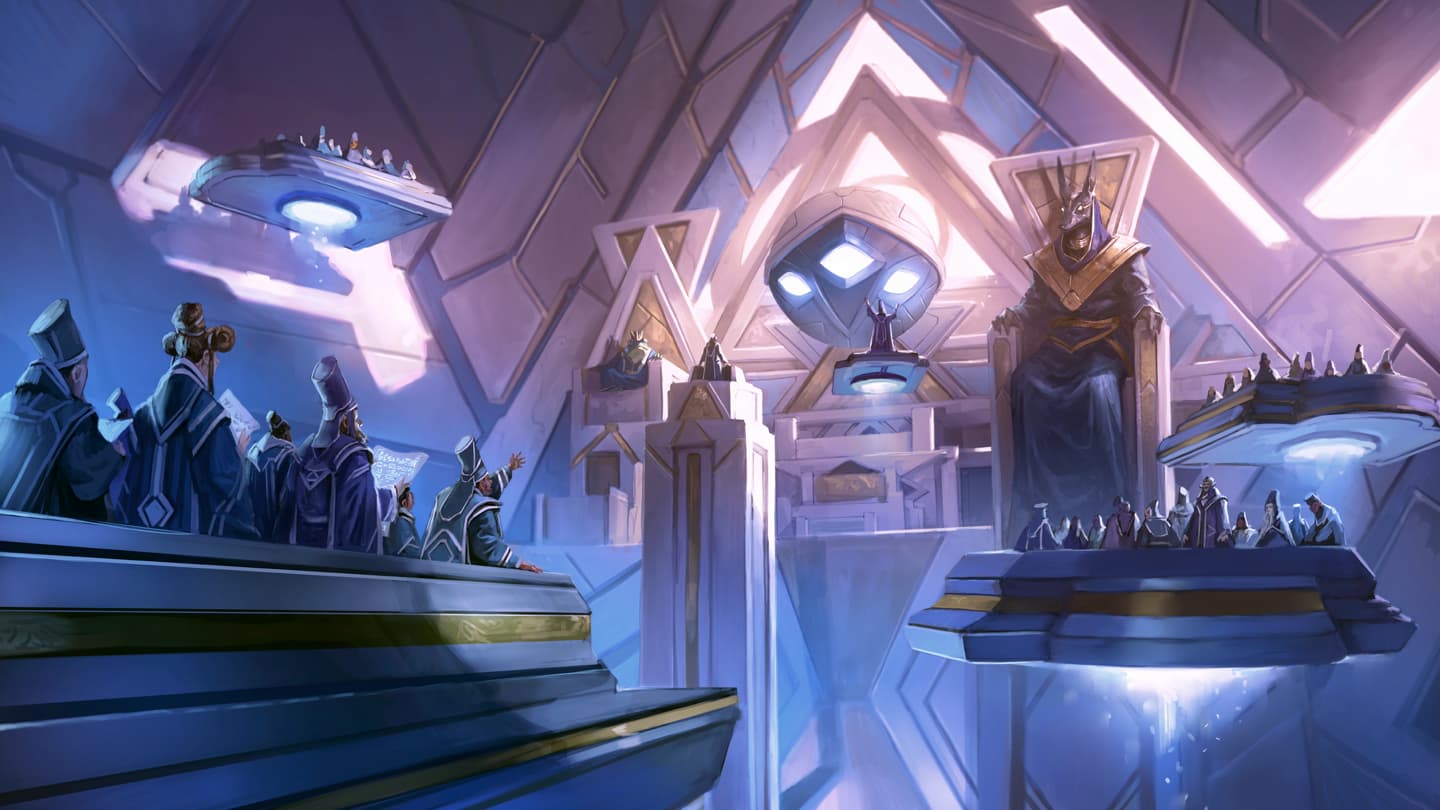
The hierarchy of the Ordis is rigid and pyramidal, perfectly structured. At its head sits the Tetrarchy, a small council consisting of three dignitaries of the Faction, to which a representative of the people is added, called for four years regardless of their social origin. Together, they determine the major orientations for the upcoming quadrennium: the major political, societal, or economic projects to define, the actions or issues to be addressed or resolved. All these recommendations then go through a popular vote, which either invalidates or concretizes them into official decrees.
But before being proposed for deliberation, these recommendations go through a whole process of study, analysis, and reflection. Various departments delve into these issues, from the clerk to the legate, encompassing a whole host of bureaucrats. This sprawling bureaucracy makes this Faction a colossus of sometimes excruciating slowness, but it reflects the Ordis's determination to weigh the pros and cons in order to make the right decision regarding a given issue. Once this cautious approach is surpassed, it is evident that the Faction becomes an unstoppable force of undeniable efficiency. However, it compensates for this relative ponderousness with an extensive network of informants. By compiling the reports these informants send, the Ordis is capable of anticipating many troubles and tensions years in advance, and of defusing them in the best possible manner.
Alteration Style : The Heka
The Alteration style of the Ordis, known as Heka, is a particular discipline that relies on the evocation of concepts through the written word. The Alterers of the Faction, known as Scribes, are able to rewrite the laws of nature, whether temporarily or permanently. To do this, they use Glyphs, which they apply to the world to manipulate it as they see fit. What they write comes to life because, for them, words and language contain the very idea of the concept they represent.
Rites & initiation
Upon their incorporation into the Ordis, its followers get tattooed with a specific Glyph, a small diamond reminiscent of the Monolith. By permanently applying this symbol, they affirm their membership in the Faction and declare that their individuality fades in favor of the collective, that their personal interests will never outweigh those of their tutelary organization. Before being granted this honor, aspirants must demonstrate diligence, efficiency, integrity, and loyalty. Only after a long initiation, consisting of examinations and intense periods of novitiate, can they aspire to enter the Faction.
But this Glyph serves another, more utilitarian function: through it, Ordis followers can link their minds, whether to converse or see through another's eyes, although this junction is limited by distance. Of course, it is necessary for the linked minds to authorize this connection so that it is not experienced as an intrusion. However, the Ordis tends to readily sacrifice this loss of individuality for the many advantages offered by this pooling of their consciousness, which they call Coalescence. The network thus formed is called the Gestalt, a space that is more than the sum of its parts: knowledge is constantly accessible there, and the exchange of information reaches an unstoppable velocity. Moreover, the pooling of minds allows Alterers to deploy Alteration abilities that a single individual would struggle to implement.
Through Coalescence, Ordis followers are perpetually connected to others, and few suffer from loneliness. In addition to perceptions and knowledge, they can transmit emotions, whether to reassure or support, encourage or soothe. But as a consequence, being cut off from the Gestalt constitutes a terrible tear, compounded by an exacerbated sense of longing...
Iconic locations
The Sanctum
Occupying the upper part of the Monolith—the white bipyramid that serves as the Bastion of the Ordis—the Sanctum is a labyrinthine library housing all the knowledge of the world. It is not uncommon to get lost in this edifice made up of tiers and intertwined platforms, connected by a maze of corridors, secret passages, stairs, air vents, and alcoves. Within this complex ziggurat, thousands of shelves line up from floor to ceiling, themselves housing countless quantities of books, grimoires, scrolls, rolls, and compilations. To maintain them, a cohort of archivists is constantly busy classifying, maintaining, and consulting them. In the scriptoria, scribes are tasked with recording new discoveries, recent accounts on paper or parchment, in an almost religious silence. In the vaulted halls dedicated to consultation, benches are provided for visitors to peruse the pages of the requested works, while librarians explore those of their registers and indexes. In recent years, the Axiom have installed Kelon powered presses in some isolated rooms to facilitate the work of scribes, although some of them complain about the hum of these machines disrupting the solemn tranquility of the place. Moreover, technology is increasingly invading the Sanctum: Kelon lanterns are gradually replacing the glow of candles; a mobile complex composed of mirrors with a thousand facets redistributes the light from the outside to the dark areas, moving according to the time to adapt to the course of the sun; small automatons ascend and descend along the shelves to allow archivists to access the high-perched books without resorting to ladders or forklifts. The Sanctum, ultimately, is as the Ordis intended it: a grand monument celebrating knowledge and wisdom, a beacon illuminating humanity with the light of wisdom.
The Anthill
The lower part of the Monolith is called the Anthill, and rightly so, as it teems with life. It is here, within a myriad of cabinets and offices located all around its perimeter, that laws and edicts are crafted. One can easily contemplate the entire expanse of Asgartha and the sea that surrounds the peninsula from here. It is also possible to observe the bustling streets of Arkaster far below, its markets, its port areas. But unfortunately, the clerks and other administrative officers who move about here rarely take the time to do so. They come and go from offices to counters, from desks to branches, carrying messages, documents, decrees to be signed or bills to be ratified. At the very bottom of the pyramid, along walkways suspended over the void, some hurry into the majestic Oratory, where rhetoricians declaim, harangue, or chant, while below, beyond the inverted pyramid skylight, the Asgarthi go about their daily activities. On the upper floors, the Assembly debates tirelessly between the marble colonnades and the benches of its sumptuous amphitheater, while the Grand Chancellor arbitrates the deliberations from his lectern. Even higher sits the Tribunal, the body responsible for dispensing justice. In this vast hall, those who have transgressed are judged, hear the verdicts, receive their sentences, under the impartial gaze of the Eidolons.
Mandjet & Mesektet
These two magnificent ships with their edged profiles—the Day Barque and the Night Barque—cruised the Asgarthan Protectorate to protect the peninsula from the tumultuous flows and the creatures that sometimes rode its currents. It was not uncommon to see their silhouette, sharp as an arrow, piercing through the clouds and casting their shadow on the landscapes below. For these flagship vessels patrolled the skies almost constantly, with Alterers on board repelling the Tumult and armed contingents ready to intervene at the slightest trouble from the outside. These elite troops, the Tagmata, represented the first line of defense against the abominations that sometimes set foot in Asgartha, threatening human communities or other species living there. Unfortunately, both ships suffered terrible damage during the last incursion of Cingula, a fierce Leviathan that regularly harasses the peninsula. But while Mesektet was lost within the Tumult and still needs to be found, Mandjet is undergoing repairs in the shipyards of the city of Sadracca, to be ready to join the Rediscovery Endeavor.
Current objectives
The Gestalt
As some of them prepare to accompany the Expeditionary Corps, the followers of the Ordis work alongside the Yzmir and the Axiom in the fabrication of the Espars, beacons that will allow Ordis Alterers to continue communicating through the Gestalt with their counterparts remaining in Asgartha. These antennas are essential prerequisites for the launch of the expedition, so that the Corps can transmit their discoveries and potential requests for assistance. For the many explorers, maintaining this connection will also allow them to indirectly converse with their loved ones and alleviate some of the isolation that is bound to weigh on their morale.
The ancient civilizations
The Ordis coordinates with the Yzmir the research efforts regarding the causes of the Confluence. While the Initiates focus on magical phenomena that may have weakened the fabric of reality, the Ordis primarily focuses on studying past civilizations, whose actions may have led to the cataclysm. The examination of relics, artifacts, and customs from ancient times has offered the Ordis an imperfect view of humanity's past greatness, but some certainties have begun to emerge within this still enigmatic tapestry. Its followers know that many mythical lands and nations existed before being erased by the Tumult, and that some may have shone across the four corners of Creation. These insights fuel wild speculations and nurture the Ordis' hope of building a unified humanity under one banner.